I came across a painting someone shared on Facebook that seemed to purposely lack context and was posted with a bit of cheek. I recognized it, though it took me a second to place it. It was one of one of Adolf Hitler’s paintings—which sent me on a bit of a thought train… It’s long been considered how different the world would be had Hitler just been accepted into art school instead of being rejected as he was. When most people see his artwork, they’re surprised to see the works are as good as they are. We of course rightly have a strong negativity bias and so considering that anything even remotely beautiful being expressed out of that mind is hard to fathom—and yet, we have the paintings. We have videos too. We see in private home videos that Hitler playfully flirts, enjoys the company of children, and plays with his dog. Even individuals who are responsible for some of the worst atrocities in history have started out as seemingly normal individuals with joys, interests, and hobbies, just like anyone else. Villains are not simply born evil, but rather are shaped by a variety of factors, including past experiences, social conditioning, and personal choices.
Based on this, I wrote this writing exercise and posted it to my Instagram. It got more responses than usual, and so I thought it might be worth looking at a little deeper. (And yes, that castle painting is one of Hitler’s works of art.)
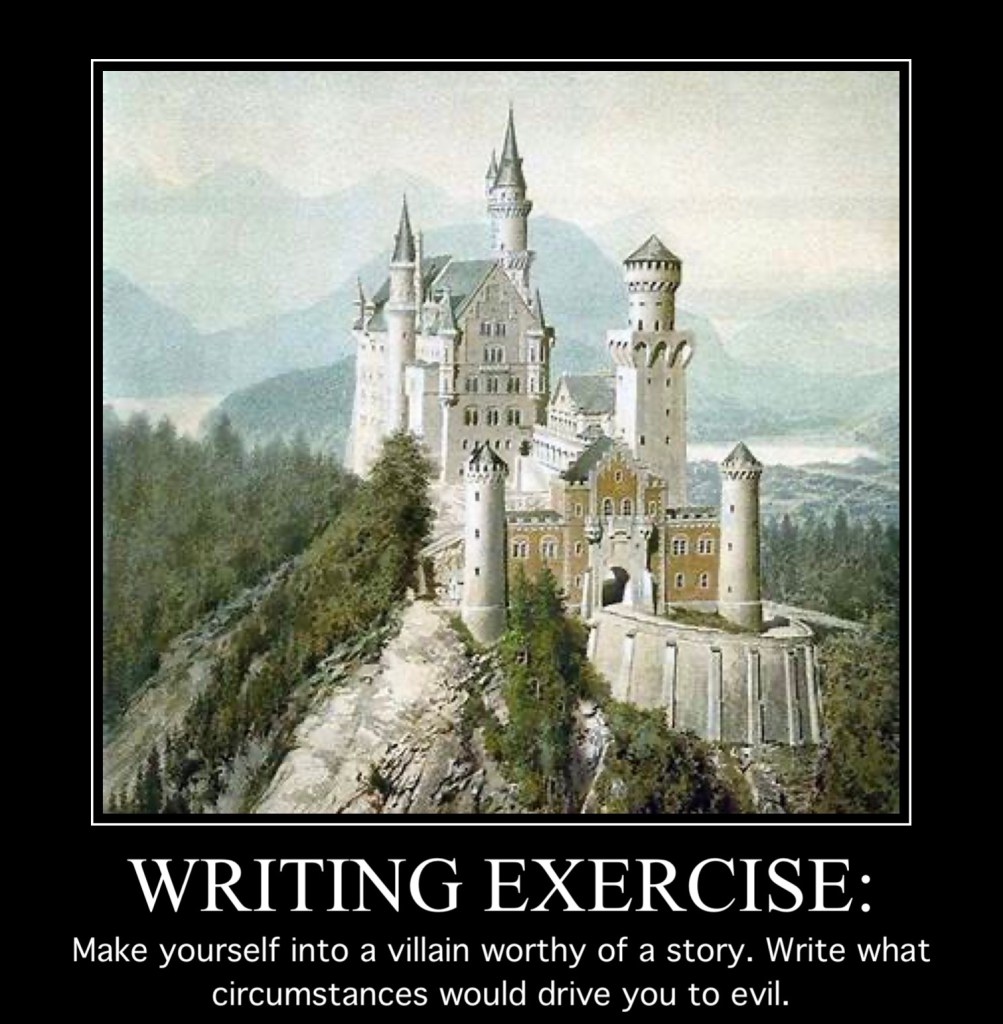
The question of how normal people can do evil things has puzzled psychologists and philosophers for decades. While it’s easy to understand why some individuals commit horrific acts due to a lack of empathy or sociopathy, it’s harder to comprehend how ordinary people can engage in cruel and immoral behavior.
One well-known psychological experiment that sheds light on this phenomenon is the Stanford Prison Experiment. In this study, participants were randomly assigned to be either guards or prisoners in a simulated prison environment. Despite being told that the experiment was only a simulation, the guards quickly began to engage in abusive and dehumanizing behavior towards the prisoners, while the prisoners became increasingly submissive and demoralized. The study was ended early due to the extreme and unethical behavior of the guards.
Another example of normal people doing evil things is the psychology of the SS in Nazi Germany. The SS was originally formed as a paramilitary organization to protect Adolf Hitler and other Nazi leaders. Over time, however, they became increasingly involved in the persecution and extermination of Jews and other minorities. Many members of the SS were not sociopathic; rather, they were ordinary men who had been indoctrinated into the ideology of the Nazi party and felt a sense of duty to follow orders. As part of their training, SS troopers were forced to raise and bond with a dog, only to have it taken away and killed in front of them. This was done to desensitize them to killing and to eliminate any empathy they might have felt towards their victims. The psychological abuse inflicted on the troops was a calculated effort to indoctrinate them into the Nazi ideology and turn them into ruthless killing machines.
Aside from the calculated traumas inflicted on SS recruits, another psychological explanation for their indoctrination is the idea of “groupthink.” When individuals are part of a group, they may feel pressure to conform to the beliefs and behaviors of that group in order to be accepted and valued. In the case of the SS, members may have felt that they needed to support the goals of the Nazi party in order to be seen as loyal and patriotic Germans. These young men thought of themselves as heroes—or at least dutiful patriots… and yet, we can see that they were quite the opposite.
Even when we do things incongruent with and against our own moral ideals, we tend to want to justify our own actions. But what sorts of things could cause us not to just live inconsistently with what we believe, but rather make us abandon those ideals wholesale? Casting oneself as a villain in a writing exercise can be a valuable exercise in self-reflection and exploration of one’s own psyche. It can be a way to delve into the darker aspects of our own personality and to better understand what motivates us.
To write a compelling villain, one must first consider the character’s backstory and what might have led them down a path of evil or villainy. This requires examining one’s own experiences and identifying potential sources of trauma or psychological distress that could lead someone to become a villain.
For example, a character who experienced a traumatic event in childhood, such as abuse or neglect, may develop a deep-seated distrust of others and a desire for power and control. Alternatively, a character who has experienced significant loss or betrayal may become consumed by anger and seek revenge against those they perceive as having wronged them.
By exploring these potential sources of trauma and psychology, writers can create complex and nuanced villains who are more than just caricatures of evil. This can also help individuals to better understand their own motivations and behaviors, and to identify areas for growth and self-improvement.
In addition, casting oneself as a villain can be a way to explore the idea of personal responsibility and agency. It can be easy to blame external factors for our own shortcomings or failures, but writing oneself as a villain forces us to confront our own actions and choices and to take ownership of them.
Overall, casting oneself as a villain in a writing exercise can be a challenging and rewarding exercise in self-exploration and creativity. It allows us to examine the darker aspects of our own psyche and to better understand what motivates us, while also creating complex and compelling characters that are more than just one-dimensional villains.
 J.E.B. Mungall