Background
I’ve been teaching at the high school level online since 2015 (you know, before COVID made it vogue to do so). But I’d had a taste of it as a student since 2010 with the Cateran Society, where I began learning Highland Broadsword. It involved reading primary and secondary sources on Highland Broadsword fencing, videoing myself and fencing partners performing these, sending them to skilled instructors, and implementing the feedback given, then working toward fencing a competent fencer of another discipline entirely. The method isn’t ideal, but it worked. After writing some online curriculum for my English and Speech courses, I considered that I should perhaps also petition my principal to approve a Highland Broadsword course–sort of a hybrid of history and PE. My then-principal agreed and I was off. I thought I’d use this medium to republish some of the informational/historical portions of that course.
Scottish Highlanders and the British Empire

During the 18th Century, the Highland Scot came into vogue in Great Britain. After years of repression and persecution of the Scottish Gael, it was ironically the Highland Regiments of the British Army that preserved many of the proud Gaelic martial traditions of the Highland Broadsword. In the British Empire, this sword-fighting tradition made its way around the world and was tested by all manner of martial arts: from Europe, to the Americas, to India, China, and Japan.
Highland Broadsword Practiced Today
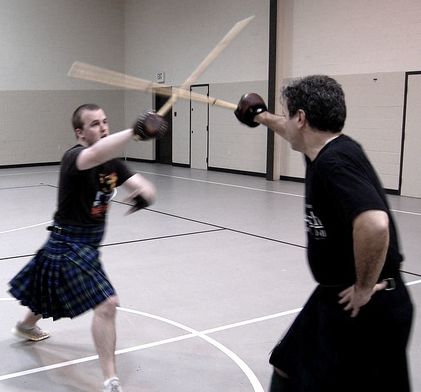
People the world over have begun to take up the old art of the Highland Broadsword. Through the research and interpretation of old Highland Broadsword manuals written by various broadsword masters in the period, dedicated swordsmen have been able to recreate and resurrect this once prolific and highly effective style of swordsmanship that is as much finesse as it is brutal force. Now, Highland Broadswords are being seen again all over the world. Broadsword Academies can be found in Germany, Finland, Russia, all over the U.S. and Canada, and of course, in Scotland and the U.K.
Singlestick and Cudgeling
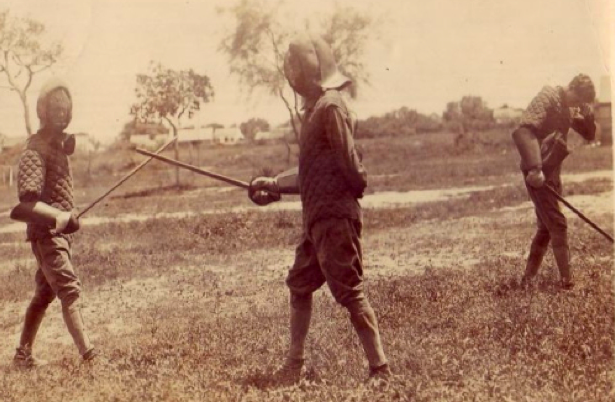
Like the Scots of centuries past, practitioners of the Art of the Highland Broadsword continue to use some of the same tried and true methods of practice: one being the use of a wooden singlestick with a leather or wicker basket to protect the hand. This training tool eventually developed into a sport in its own right called “singlestick” or “cudgeling”. This system was even at one time an Olympic event! Though short-lived there, it has seen a great resurgence and is used by not only Scottish, but also English, Irish, and American fencing systems.
Historical European Martial Arts (HEMA)
Historical Scottish fencing is not the only European martial art that has been rediscovered, revived, or relearned from old written sources. There are many different styles of Historical European Martial Arts (HEMA) that have come to light with varying degrees of popularity in recent decades. These range from German and Italian Longsword, English broadsword and smallsword, Irish and French stick-fighting, wrestling styles from all over, French, Spanish, and Italian rapier, Polish saber, and the list goes on and on. Unlike with Eastern Martial Arts, like Kung Fu or Karate, there is not a linear unbroken line of master to apprentice for most of these arts. When reading older sources, sometimes interpretations will need to be made and sometimes scholars and practitioners will disagree with one another.
Closing
Highland Swordsmanship is not only part of a rich and varied combat tradition of Europe, but also part of the tapestry of Scotland’s storied culture, illustrating both the mystique of the Scottish warrior and the narrative of cultural borrowing and transfer from those around it, and also its interplay around the world with those whom the British Empire colonized, battled, and defended prior to the advent of mechanized warfare.
 J.E.B. Mungall