Tag: fantasy
-
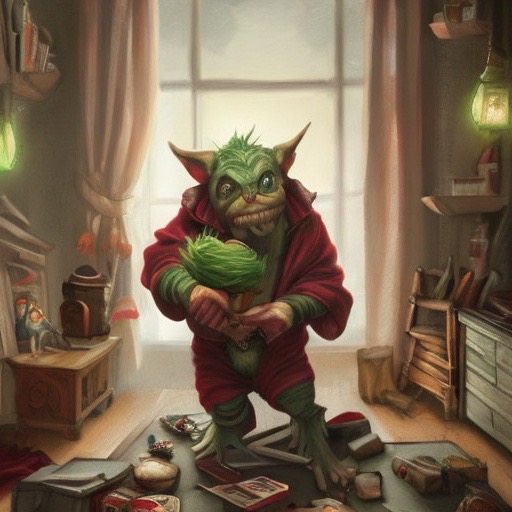
Goblin pilfering your bedroom I came across this post on Tumblr via a repost on Facebook some time back. It’s posed simply as a “fantasy idea” and discusses goblin culture. Goblins are of course a common folklore and fantasy trope, so going into their long history is unnecessary except to say that goblins are almost universally villainous, destructive, capricious, or downright evil—the exceptions that appear in modern fantasy are generally purposeful exceptions (like Squee in the Magic: The Gathering franchise.) What Homunculus-argument poses with this idea about goblins though seems to reject the idea inherent in so much literary and gaming baggage, that goblins are purely evil, but rather they simply have a culture that is so vastly different to our own in a simple, but profound way: they lack all concept of private property and privacy.
The concept of private property has been central to human civilization for thousands of years, and it has played a crucial role in shaping our societies and cultures. The idea that individuals or groups of individuals can own and control land, resources, and other forms of property is a fundamental aspect of our economic, legal, and political systems. Private property has allowed for the development of trade, commerce, and markets, enabling individuals to accumulate wealth and pursue their own self-interests. It has also been a driving force behind the development of technologies and innovations that have improved the quality of life for people around the world.
Of course, this view is challenged by communist theory which advocates for collective ownership of property and resources. In a communist society, individuals do not own private property, and instead, all property and resources are owned collectively by the community or the state. Though, this generally doesn’t preclude personal belongings—like one’s clothing, tools, food, etc. When communist types advocate abolishment of private property, they don’t usually mean the community has a right to your pajamas.
This idea of goblin society however, WOULD take the concepts behind communism and take them far beyond what civilized humans are willing to tolerate. Goblin civilization in this theory is Uber-communistic. That is, everything from the milk in a baby’s bottle, to the clothes on your back, to the bed you sleep in is always communally shared and up for grabs. This thusly precludes any concept in their civilization of theft. Thusly “raiding” (which is a popular goblin trope) is merely a self-defense action after being resisted for attempting to take what’s rightfully “up-for-grabs.”
One thing that I can really appreciate that Homunculus-argument does in this theory is that they also consider how a culture lacking a concept of private property pertaining to concrete objects would translate too to the abstract—that there is no concept of private information. That a goblin who could be engaged in polite conversation would completely divulge all manner of information about themselves to the point most humans would consider it “over-sharing.” There is no issue of “that’s personal,” or “that’s a secret.”
This fundamental cultural difference between goblins and humans goes a long way to explain longstanding and irreconcilable conflicts between the two races. Perhaps this originated on reflection between capitalist and communist nations, but taken to a greater and more fundamental degree. It is a lot better than the simple hand-waving of “oh, well goblins are just evil.” I have always to say, “tell me exactly why they’re evil.” The suggestion that they’re just cruel, conflict-craving, monsters can suffice, but it’s hardly satisfying. Besides, it’s hardly a leap to suggest that humans have the capacity to be cruel, conflict-craving monsters too. Yet, I’ve never gotten the idea from fantasy literature that goblins are symbolic of our worst natures. Now, I do NOT believe that this sort of cultural difference explanation absolves goblins of their evil nature either. There’s no reason to ascribe to any post-modern concept that all cultures have some inherent equal worth and value to the world as a whole. Even if you’re not a moral absolutist, when pressed, most people would agree for instance that a culture who believes in beating women with canes and rubber hoses on the street is not of equal worth to the world than a culture that holds such treatment of women reprehensible. So too, characters in a fantasy world have no obligation to respect this goblin culture. It would in theory conflict with multiple fundamental principles shared by all of civilized humanity—very broadly: a right to your belongings, a right to defend those belongings (and yourself), and a right to collect and protect resources necessary to survive.



 J.E.B. Mungall