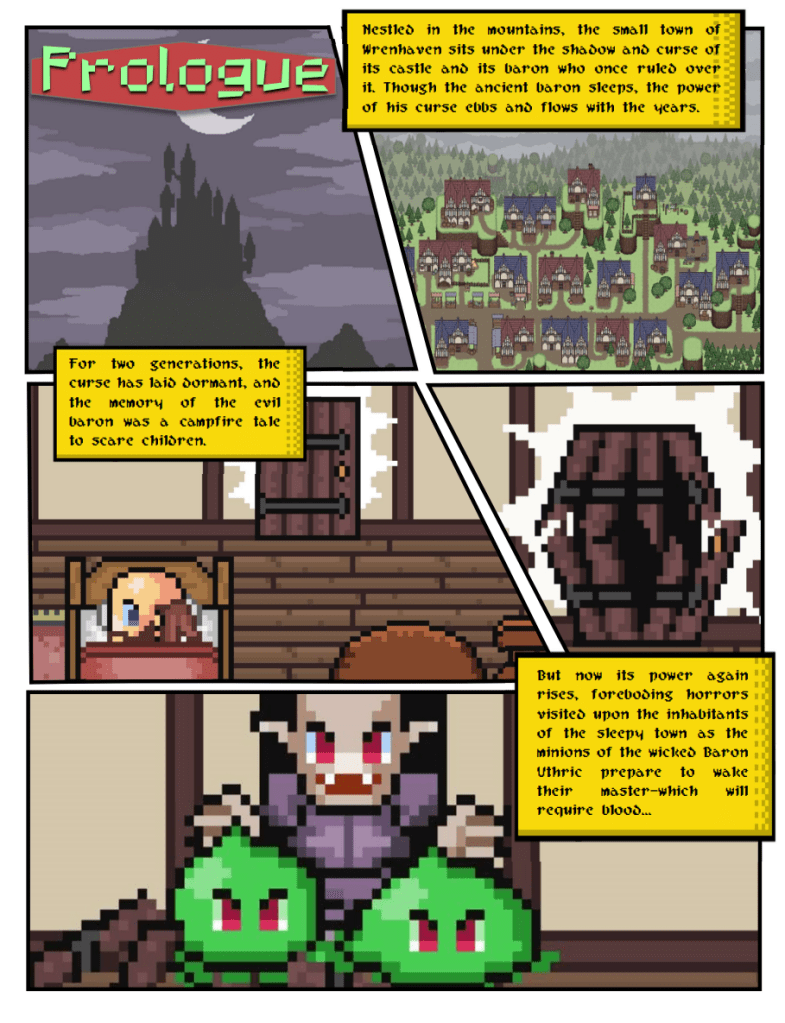
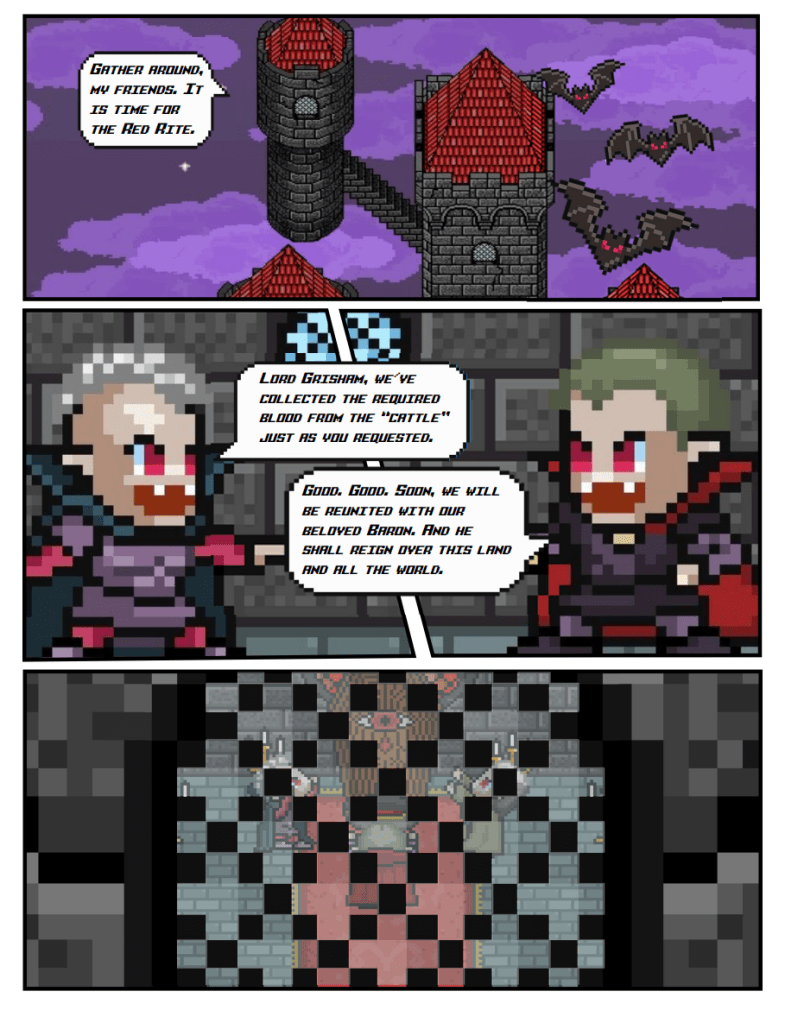
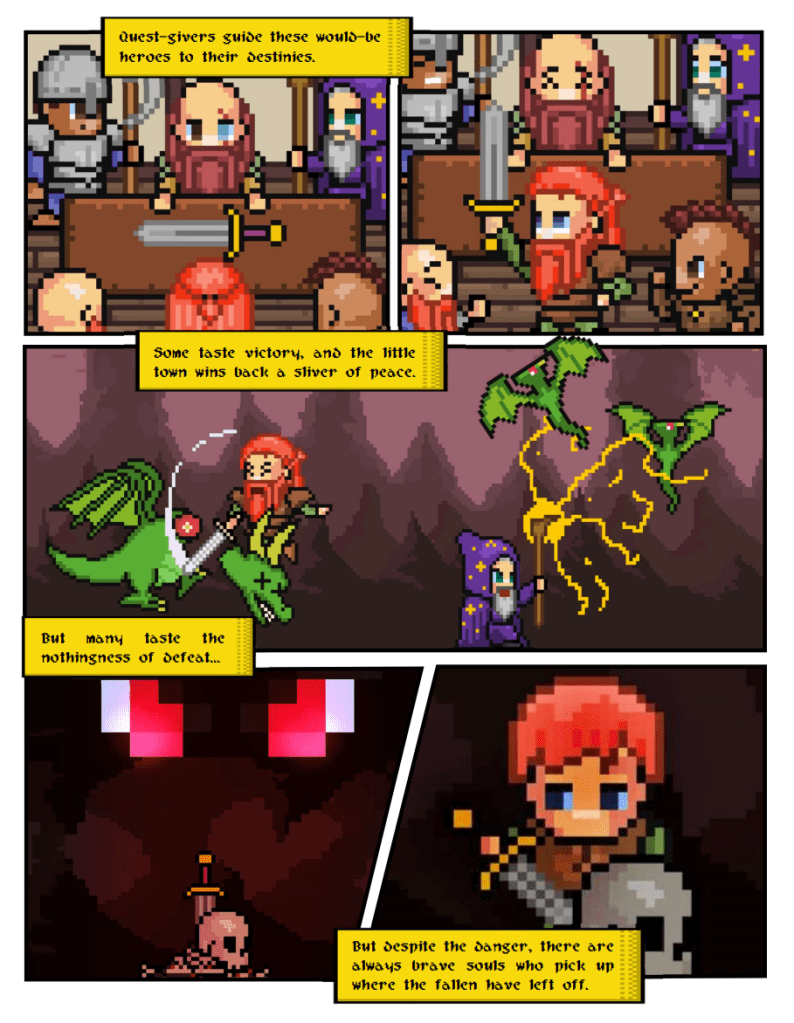
Today, I’m excited to share with you a sneak peek of a project I’ve been working on: a graphic novel inspired by the popular video game series, Castlevania, called Wrenhaven. I’m presenting this in a comical and cute pixel art style in an attempt to add a touch of humor to the serious and gothic setting of these sorts of vampiric tales. While still a work-in-progress, I hope you’ll enjoy this first look at Wrenhaven and share in my enthusiasm for this exciting new project.
As a society, we often find ourselves caught up in the trap of moral posturing, feeling a sense of righteousness in condemning the evil and atrocities committed in the world. However, simply hating evil is not enough, and to truly be a moral actor, we must take action to do good. It is easy to assign blame and point fingers at the problems we see, but does this really make the world better or does it create more anger and division? While it may not be feasible for every person to take meaningful action on every issue, it is still important for individuals to be informed and engaged on the issues that matter to them. This involves educating themselves on the issue and sharing that education with others. However, there is a good and bad way to do it, with moral posturing being the latter.
While we should hate evil, true morality is not about feeling good about ourselves for hating it. Just like love is an action rather than a feeling, so too is hate. Hating evil is about taking action against it, and in so doing making the world a better place. Moral posturing can be a problem when it comes to the issue of something like climate change, racism, or mass shootings because it can give people the impression that they are doing something to address the problem when in fact, they are not taking meaningful action. In other words, it can lead to a false sense of accomplishment and complacency, which can be harmful in the face of an urgent and complex problem.
But what does meaningful action look like? That depends on your individual circumstance.
It is not necessarily feasible or practical for every single person to take meaningful action on every issue they hold a strong opinion about. There are many issues in the world that require attention, resources, and action, and it is not possible for any one person to address all of them. It is also important to acknowledge that individuals have different capacities, interests, and priorities, and what is meaningful action for one person may not be the same for another. I’m reminded of the poor widow’s offering in the Bible. The parable of the woman who gave a coin to the offering teaches the lesson that the value of an offering is not determined by its size, but by the sacrifice involved in giving it. In the story, a poor widow gives two small coins as an offering, while a rich man gives a large amount of money. Despite the difference in the amount given, Jesus points out that the widow’s offering is more significant because it represents a greater sacrifice. The widow gave out of her poverty, while the rich man gave out of his abundance. Thus, the parable teaches that true generosity is not about the amount of money or material possessions given, but about the spirit of sacrifice and selflessness behind the gift.
Taking meaningful action requires time, resources, and energy, which may be limited for some individuals. People may have other responsibilities and commitments, such as work, family, or personal health, that make it difficult to devote significant time and energy to every issue they care about. The widow gave out of her poverty, and so each person needs to give of themselves to that which they care about. A single mother working two jobs may feel strongly about an issue like climate change, but her resources are limited to contribute to making change. Her priority is seeing to it that she and her children are properly nurtured and cared for. A college student may have energy and time but limited financial resources and so may be able to give more than the single mom. A well-off retiree has finances and time, but may have limited energy. Every person should ask themselves where they are and what they’re wasting: time, energy, money, talent, connections? It’s important to recognize that meaningful action can take many forms, and that small actions can add up to make a difference. But everyone should remember that they’re not going to change the world themselves. Nor is their voice so powerful that it alone will lead to some tangible change.
Even those who take meaningful action must avoid the trap of moral posturing. They must recognize that their efforts, while valuable, are only one part of a larger solution, and that there is always more work to be done. They should also avoid judging or condemning others who are not able to take the same level of action or who have different opinions or approaches to the issue. Instead, they should seek to build bridges, educate others, and work collaboratively towards a common goal.
Sexual selection refers to the process by which certain traits are favored in a species due to their attractiveness to potential mates. In the human species, sexual selection is often driven by females, who have the ability to choose their partners based on a variety of factors. One key factor in female sexual selection is the display of traits that signal good genes and overall fitness, such as physical attractiveness, intelligence, and social status.
Research has shown that women are more likely to choose partners who display traits associated with good health and genetic fitness, such as symmetrical facial features, a deep voice, and a masculine physique. In addition, women are often attracted to men who possess traits associated with social status and wealth, such as high levels of education or a prestigious occupation. These preferences may reflect the ancestral environment, where males who possessed these traits were more likely to provide resources and protection for their offspring, increasing their chances of survival and reproductive success.
When examining the portrayal of male love interests in harlequin romance novels, it becomes apparent that many of them fall into certain archetypal categories that appeal to female readers. The heroes in these novels often possess traits that signal strength, power, and status, and are frequently portrayed as vampires, pirates, werewolves, billionaires, and surgeons. These archetypes may serve as stand-ins for the traditional “knight in shining armor” fantasy, providing readers with a form of escapism and wish fulfillment. However, it is worth exploring how these archetypes fit into the larger context of female sexual selection, and how they reflect deeper psychological desires and preferences.
One common thread that runs through many of these archetypes is the idea of the “beastly” or “wild” male who is tamed and domesticated by the female protagonist. This trope is particularly prevalent in the portrayal of werewolves, vampires, and other supernatural creatures, where the male love interest is often depicted as a dangerous and unpredictable force that can only be controlled by the love of a good woman. This theme is also present in the portrayal of billionaire and surgeon characters, who may be emotionally closed off or otherwise distant until they are “tamed” by the female protagonist’s love. This idea of taming the beast taps into deeper psychological desires for control, safety, and security, as well as a desire to transform and shape our partners to fit our idealized notions of love and romance.
While the heroine archetype in romance novels often involves the taming of a beastly male, the male hero archetype frequently involves the opposite dynamic: the protection of a vulnerable female from a dangerous and unmitigated beastly threat. This theme is often seen in the portrayal of male characters as knights, soldiers, or other protective figures, who use their strength and bravery to shield their female love interests from harm. The contrast between these archetypes reflects broader cultural narratives about gender and power, with the male hero representing strength and dominance, and the female hero representing control and transformation. Despite these differences, both archetypes speak to deep-seated psychological desires for love, security, and protection.
The development of the male hero archetype can be traced back to ancient storytelling traditions, where men would tell tales of great heroes who possessed certain characteristics that were seen as desirable to potential mates. These characteristics included physical strength, courage, and intelligence, as well as the ability to provide for and protect their loved ones. Over time, these archetypes became embedded in cultural narratives, and were reinforced through literature, film, and other forms of media.
The male hero archetype can be seen as a form of appealing to the sexual selection governed by females across cultures in the human species, in which men who display these traits are seen as more attractive to potential mates. At the same time, these archetypes also reflect universal cultural ideals about masculinity and power, which have evolved over time in response to changing social and economic conditions.
Despite their historical roots, the male hero archetype remains a powerful and enduring cultural trope, reflecting deep-seated desires for strength, courage, and protection. While the specific characteristics of the hero may change over time, the underlying psychological motivations remain the same, and continue to shape our cultural narratives and our ideals of romance and love.
I decided to look for this in my own writing, and while it’s obviously present in The Legend of Tam Lin, the plot and characters are products of Scottish folklore. I turned to Antiphon: Fire and Stone to see if this concept shows up, and I think it does. Kord, who struggles with his supernatural ability to conjure up fire, is in a great sense beastly and untamed. However, he is seeking to control it and finds great help and solace with his romantic interest in the tale, Meara. Awyn, on the other hand, being a postulant monk has no mitigating romantic interest, and though his gift is much less “beastly” than destructive fire, he has a troublesome knack for acting impulsively and rashly (to his detriment) that his platonic friends do not do well to wholly mitigate before the damage is done. I would be curious to hear what you think of this analysis and hope you check out Antiphon: Fire and Stone on Amazon.
What follows is another excerpt from my work-in-progress on teaching English Language Arts with AI-Tools, like ChatGPT.
In a political and educational context, “equality” refers to the idea that all individuals should be treated the same and have equal access to opportunities and resources regardless of their background or circumstances. The aim of equality is to provide equal treatment and opportunities for all individuals, so everyone has a fair chance to succeed.
“Equity,” on the other hand, recognizes that not everyone starts from the same place and that treating everyone the same may not address existing inequalities and may even perpetuate them. Instead of treating everyone the same, equity seeks to balance out unequal starting points by providing additional resources and support to historically marginalized groups so they have a fair chance to succeed. In this sense, equity focuses on fairness and justice, rather than just equal treatment.
In a nutshell, equality aims to provide equal treatment to all, while equity seeks to balance out unequal starting points and provide fairness and justice to all individuals, regardless of their background or circumstances.
It’s no secret that the term “equity” has become a political buzzword in recent years, and its use has become a source of controversy and division. Some view the term as synonymous with reverse discrimination and believe that it promotes a culture of victimhood and political correctness. They argue that equity initiatives can create new forms of discrimination, as well as stifle freedom of speech and expression.
However, advocates of equity view it as a way to address historical systemic injustices that have disadvantaged certain groups of people. They argue that equity initiatives are necessary to ensure that everyone has an equal chance to succeed and that existing power structures must be disrupted to achieve true equality.
We should recognize that there is a wide spectrum of views on equity initiatives among advocates, and there is no consensus on how far these initiatives should go. Some believe that equity initiatives should focus on providing equal opportunities and removing barriers that prevent marginalized groups from succeeding. Others argue that equity should go further and aim to provide compensatory resources and support to those who have been historically disadvantaged, so they can catch up with others.
AI tools like ChatGPT can play a role in addressing equity issues in writing education in several ways:
Improving writing skills for non-native English speakers: ChatGPT can assist non-native English speakers in improving their writing skills by providing suggestions for grammar and vocabulary, allowing them to express their ideas more effectively and participate more fully in the writing process.
Providing personalized feedback: ChatGPT can provide personalized feedback to students on their writing, helping them to identify strengths and weaknesses, and offering suggestions for improvement. This can provide students with targeted support and help close gaps in writing skills.
Offering writing support to students with disabilities: ChatGPT can provide writing support to students with disabilities, such as those with dyslexia or visual impairments, by offering alternative forms of feedback and support that are accessible to all students.
Increasing writing accessibility: ChatGPT can help to increase the accessibility of writing education by providing students with writing support that is available at all times, regardless of their location or schedule. This can help to remove barriers to education and provide all students with equal opportunities to improve their writing skills.
Ultimately, AI-tools address both issues of equality and equity as they can address each individual’s needs, situation, culture, deficits, and excellence. AI-tools can help those with writing deficits build their writing competence and confidence. Additionally, for good writers, AI-tools can serve as a helpful tool for editing and refining their writing, helping to ensure that their writing is clear, concise, and effective. Overall, AI-tools like ChatGPT can support individuals in their writing efforts and help individuals of all writing abilities improve their skills and reach their full potential.






 J.E.B. Mungall